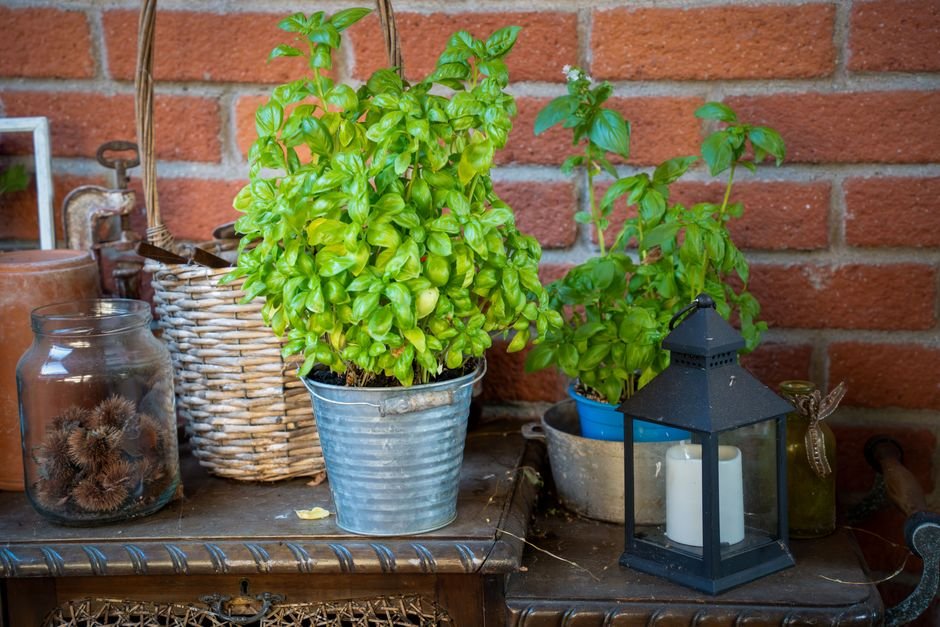
I bought a pot of basil on a Tuesday, put it on the windowsill, used maybe six leaves, and by the following Monday it was a huddle of yellow stems leaning against the glass. Two pounds gone. I did this repeatedly for about two years before I got curious about why it happens so reliably.
It happens because the pot is not what I assumed it was. I thought I was buying a young plant that would grow. I was buying something closer to a bouquet with a root system, grown fast under ideal conditions and sold at the moment it looks best.
What is actually in the pot
Tip one out and look at it. There is not one basil plant in there. There are dozens of seedlings, sown thickly, packed into a small volume of light peaty compost, roots wound around each other in a solid mass.
That density is deliberate. It makes the pot look full and lush on the shelf, which is what sells it. It also means every one of those seedlings is competing with the others for water, root room and light, in a pot with barely enough compost for one plant.
These plants have also been raised somewhere consistently warm and bright with steady feeding. Your kitchen is neither of those things. So the pot arrives at its peak and starts going downhill the moment it reaches you, and no amount of careful watering reverses that.
Why it collapses in a week
The usual sequence in my kitchen went like this. Day one, it looks great. Day three, the compost has dried out completely, because a dense mass of roots in a small pot drinks fast, especially over a radiator. I water it heavily. Day five, some lower leaves go yellow and the stems near the base look dark and soft.
That base rot is the killer. Crowded stems with no air moving between them and wet compost is a reliable way to lose plants, and once the stems go soft near the soil there is nothing to be done. The top can look fine for another day or two while the plant is already finished.
The other failure is simply picking wrong. I would strip the outer leaves, which are the biggest, and leave the growing tips. As with any basil, that removes the leaves the plant cannot replace and leaves it a collection of bare stalks.
The one step that actually helps
Splitting the pot. This is the only thing I have found that reliably turns a supermarket pot into something that lives for months rather than days.
I tip the whole thing out, soak the rootball in a bowl of water for a few minutes so it loosens, then tease it apart into three or four clumps. It feels violent. Roots snap. Do it anyway. Then each clump goes into its own pot, a proper one with drainage, in ordinary potting compost, planted at the same depth it was at before.
They sulk for about a week and then they start behaving like real plants. Suddenly each clump has room, air can move between the stems, and the roots have somewhere to go. My best result from a supermarket basil was three pots that lasted from May into September and got cut from constantly.
Which ones are worth saving
Basil is the one most worth splitting, because a decent basil plant is genuinely useful and mine outdoors are unreliable. Mint from a supermarket pot also transplants well, though I would only ever put it in a container, for reasons I have written about and still regret.
Parsley splits reasonably well and rewards it, since a settled parsley plant will keep producing for a long stretch. Chives are the easiest of all. Pull the clump apart, plant the divisions, and they carry on as if nothing happened.
Coriander I do not bother with. Mine bolts almost immediately after being disturbed and I get nothing worth the effort. Rosemary and thyme sold as small pots are usually single cuttings rather than a crowd, so there is nothing to split. Those I just repot into gritty compost and put outside in the sun, where they do far better than they ever did on the sill.
The mistakes I made trying to rescue them
Before I worked out the splitting trick I tried a lot of things that did nothing. Standing the pot in a saucer of water permanently was the worst of them. It kept the compost soaking and the stems rotted faster than if I had just let it dry out and wilt.
Feeding it was another wasted effort. I bought liquid feed and gave a struggling pot a dose, thinking hunger was the problem. It was not. The problem was thirty plants in a space meant for one, and no fertiliser fixes overcrowding.
Moving it around chasing light helped slightly and cost me a plant when I left it outside on a cold night in April. These pots are raised indoors and they have not hardened off, so a cold night hits them harder than a plant that grew up outside. Now if I move a split pot outdoors I do it once the nights are properly mild and I do it gradually, an hour or two at a time for a few days first.
What I expect from one now
If I am not going to split it, I treat the pot as a bunch of herbs that stays fresher than a cut bunch. I keep it somewhere bright but not against hot glass, water it when the top of the compost feels dry rather than on a schedule, cut from the tips rather than stripping the outside, and I use it up within two or three weeks without pretending I am growing anything.
Judged that way it is decent value, and I stopped feeling like I had failed when it ran out. If I do want a plant out of it, I split it on the day I bring it home, before it has had a chance to start going backwards on the windowsill.
The mistake was never the plant. It was buying a short term product and expecting a long term one, then blaming myself when it behaved exactly as designed.