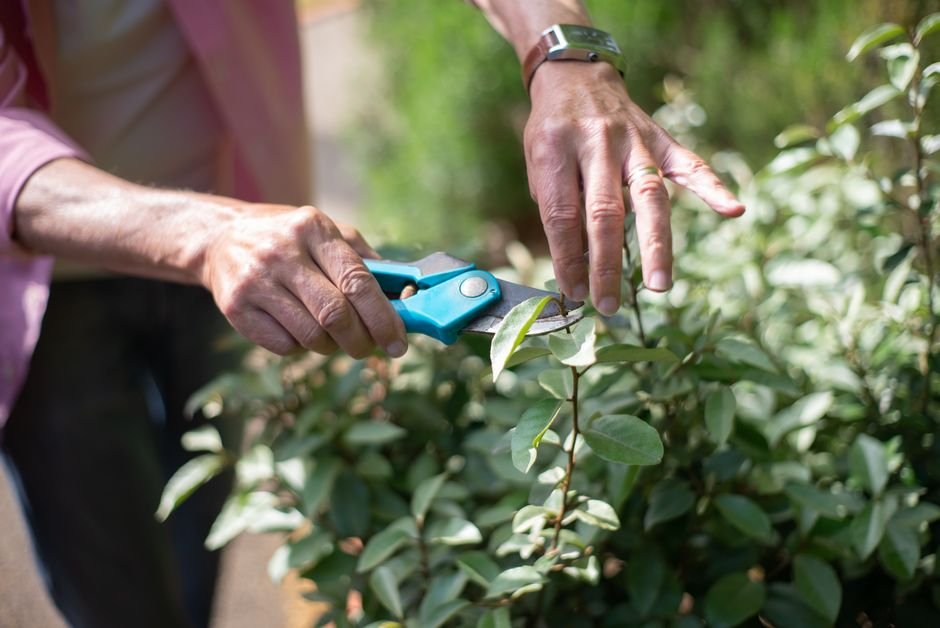
My first basil plant ended up looking like a small tree. A bare stem about a foot tall with a tuft of leaves on top, like something out of a cartoon. I had been picking leaves off the bottom because they were the biggest and easiest to reach, and I had never once cut the top. I had, without meaning to, pruned it into a lollipop.
Once someone pointed this out to me I started paying attention to where I was cutting, and my herb plants roughly doubled in output the following year. Same plants, same soil, same water. Just a different pair of hands.
The bald basil problem
Soft herbs like basil grow from the tip. Left alone, the plant puts most of its energy into extending that single main stem upward, and eventually into flowering. Every leaf you take off the lower stem is a leaf that plant will not replace, because that is not where the growing happens.
So the plant that gets picked from the bottom gets taller and barer and finally flowers, and then the leaves turn small and taste different. The plant that gets cut at the top does something else entirely. It stops going up and starts branching sideways.
That branching is the whole game. One stem becomes two, two become four. A basil plant I have cut properly through the summer ends up short, wide, dense, and producing far more than the tall one ever did.
Cut above the fork, not below
Look down a stem of basil or mint and you will see pairs of leaves, and where each pair meets the stem there are usually two tiny leaves just getting started. Those are the new branches waiting to go. Cut the stem just above that pair, a small distance up, and both of those tiny shoots take off within days.
Cut below them and you have removed the plant’s next move. Cut halfway through a bare section and you leave a stub that dies back and looks miserable.
I use scissors rather than fingers for anything thicker than a thread. Pinching soft tips with fingernails is fine and honestly quicker, but tugging at a stem you cannot break cleanly tends to loosen the whole plant in the soil, and I have pulled young herbs half out of the ground doing exactly that.
Take more than feels polite
This was the hardest habit to change. I used to take three leaves at a time because the plant looked small and I felt bad. Taking three leaves gives the plant no signal at all, and it just carries on marching upward.
Now I take a whole growing tip with several sets of leaves under it, and I take it from the tallest stem, and I do it even when I only need a little. What I do not use goes in a glass of water on the counter and lasts a few days.
The rough rule I follow is not to take more than about a third of a plant at once, and to start only when the plant has a decent set of leaves on it. Beyond that, more cutting means more plant. Basil, mint and parsley all responded to being cut harder and more often, without exception, in my garden.
Soft herbs and woody herbs want different things
Everything above applies to the soft green ones. Basil, mint, and to some extent parsley, though parsley is a bit different because it grows from the centre rather than the tips. With parsley I take whole outer stalks right down at the base and leave the small new growth in the middle alone. Picking individual leaves off parsley leaves you with a plant full of bare stalks.
Woody herbs are another matter. Thyme, rosemary and sage build permanent woody structure, and if you cut back into old bare wood, most of the time nothing comes back from that point. I learned this on a rosemary I cut hard in autumn hoping to tidy it up. It sat there, brown and unchanged, until I gave up on it the next summer.
So with those I only ever cut into the softer green growth of the current year, taking the tips, and I do it in the growing season rather than late in the year. A light trim after flowering keeps a thyme plant dense instead of splitting open in the middle, which is what mine does when I ignore it.
Flowers, and when I let them happen
Once basil or mint starts making flower buds, the plant is winding down its leaf production and the leaves start tasting different, usually flatter and slightly bitter. So I pinch flower buds off as soon as I see them, and that alone extends the useful season by weeks.
Chives I treat differently, because the flowers are worth having on a salad, and the plant does not seem to mind. I let it flower, enjoy it, then cut the whole clump back to a few inches when the flower stalks go tough. It regrows soft and green within a couple of weeks.
Coriander I have given up trying to stop. It will flower whatever I do, and at that point I let it run to seed and collect what I get.
A schedule that fits a weekend
I do not have a system with dates in it. What I actually do is a walk round with scissors on Saturday morning, coffee in the other hand, taking the tallest tip off anything that has one. It takes about four minutes and it doubles as the moment I notice slugs, dry pots, and things starting to bolt.
Then there are two or three points in the season where I cut something back to almost nothing. The mint gets that treatment several times. The chives get it once after flowering. The parsley gets a hard strip in midsummer when it starts looking tired. Every time, the regrowth is better than what I removed, and every time I feel briefly like I have ruined the plant.