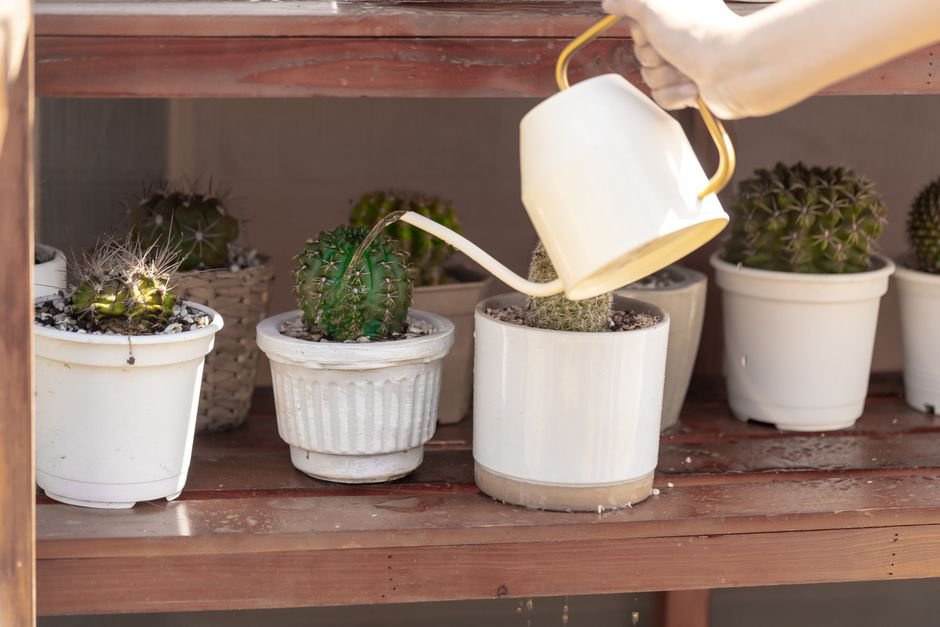
I got back on a Sunday evening in July after two nights at a friend’s place, opened the balcony door, and found the basil lying flat over the rim of its pot like something had let the air out of it. The soil had pulled away from the sides of the container. When I poured water in, most of it ran straight down that gap and out of the drainage holes without wetting anything. The plant came back about halfway over the next few days and never really recovered.
That was the evening I stopped thinking of watering as a small task attached to growing things in pots, and started thinking of it as the main task.
Why containers are so much thirstier
A plant in the ground sits on top of a very large reservoir. Its roots can go sideways and down, and the soil around it holds moisture that took days of weather to put there. When the surface dries, there is still plenty underneath.
A pot has none of that. It holds a fixed and fairly small amount of soil, it is exposed to air on every side, and on a balcony it is often sitting on a hard surface that heats up and against a railing that gets wind. Wind is the part people underestimate. A breezy overcast day can dry my pots faster than a still warm one, and I did not believe that until I watched it happen.
So the whole reservoir empties in a day or so in high summer. That is not a failure of my soil or my technique. It is what a pot is.
The finger test and nothing fancier
I do not own a moisture meter and I have never wanted one. What I do is push a finger into the soil near the edge of the pot, past the first knuckle, once in the morning. If it comes out with damp soil clinging to it, I leave it. If it feels dry down there, I water.
The reason I check rather than schedule is that the right frequency changes constantly. In a cool cloudy week I might go two or three days. In a hot windy stretch the same pot needs water every single day and sometimes wants a second drink in the evening. Any fixed schedule is wrong most of the time, in one direction or the other.
Watering properly, not often
My other early mistake was frequent small splashes. A little water on the surface every morning feels attentive and is close to useless. It wets the top layer, the roots stay shallow chasing it, and the bottom of the pot stays dry.
Now when I water I water until it runs out of the drainage holes, then wait a moment and do it again. If the pot has dried out to the point where the soil has shrunk from the sides, that first pour just escapes down the gap, so I water it once to close the gap and then again properly. For a badly dried pot I sometimes stand it in a basin of water for a while and let it take up moisture from the bottom, which works better than anything I can do from above.
Bigger pots buy time
The most effective change I made was not a technique, it was going up in pot size. A larger container holds more soil, more soil holds more water, and more water means a longer gap before the plant is in trouble.
I will not pretend I can tell you how many days a given size buys, because that depends on the plant, the weather, and my particular windy railing. What I can say is that my small pots need attention every day in summer and my largest tub does not, and when I replaced a couple of the small ones with fewer larger ones I lost fewer plants. The trade is weight and space, both of which matter on a balcony, so it is a real decision rather than an obvious upgrade.
Saucers, mulch, and grouping
Three small things that helped. Saucers under the pots catch what runs through and let the plant take a bit back up, which also keeps my downstairs neighbor from wearing my drainage water. I do not leave a pot standing in a full saucer for days, because roots sitting in water is its own problem, but through a hot day it is useful.
A layer of something on the soil surface slows evaporation. I have used bark and I have used gravel and both were better than bare soil sitting in the sun.
Grouping pots together rather than spacing them along the railing seems to help too, partly shade for each other and partly a bit of shelter from the wind. It looks less tidy. It works better.
What I do when I go away
I have tried the bottle upended in the soil trick and found it unreliable. What works for me is moving everything into the shadiest corner before I leave, watering deeply, and standing the smaller pots in a shallow tray with water in it. That covers a weekend. For anything longer I ask a neighbor, and I show them the finger test rather than telling them to water everything daily, because enthusiastic daily watering of pots that do not need it has killed things for me too.
The blunt version is this: if you cannot commit to checking your pots most days in summer, grow fewer of them and grow them in bigger containers. That is not a discouraging thought, it is just the actual shape of the job.