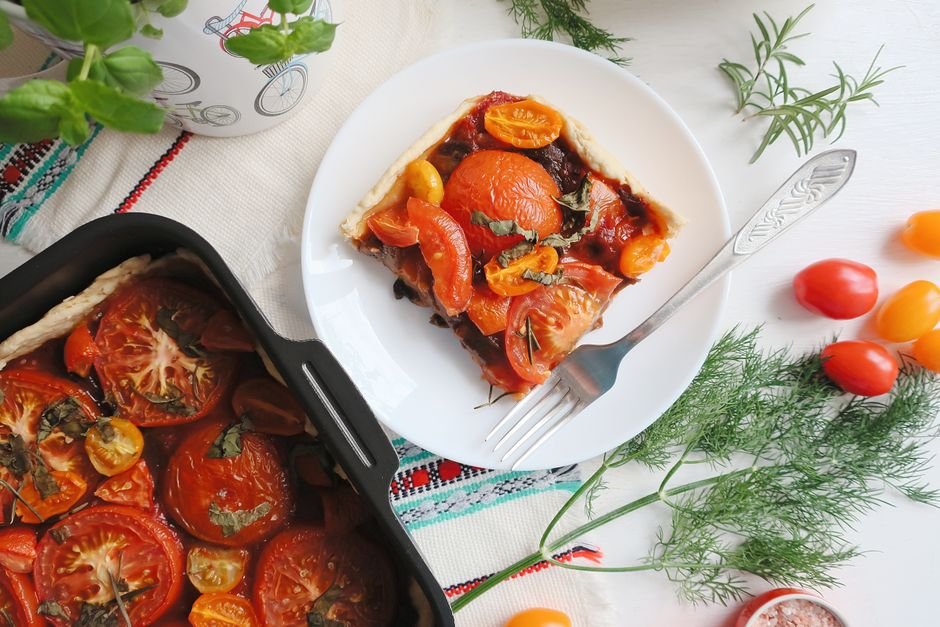
The first properly ripe tomato of last July never made it to a plate. I picked it around six in the evening, brought it inside, meant to slice it into something, and instead stood at the counter with a paring knife and the salt cellar and ate the whole thing in about six pieces, leaning over the sink so it did not get on my shirt. It was warm from the bed. That was dinner for about ten minutes until I remembered other people lived here.
That tomato was better than anything I cooked with tomatoes for the rest of the summer, and I cooked with a lot of tomatoes.
The year I ruined everything good
My second season, I had finally gotten decent yields, and I decided the produce deserved a serious treatment. I made a very involved ratatouille that took most of a Saturday afternoon. Everything went in, all of it homegrown, all of it picked that morning. The result was brown and uniform and honestly tasted like every other ratatouille I have ever had. Fine, but the individual vegetables had disappeared into a general vegetable flavor.
I did the same thing to a bowl of the first peas, which I creamed into something with a lot of butter and cream and a little nutmeg. The peas came out tasting like the sauce. I had spent four months growing an ingredient and then twenty minutes covering it up.
What I was actually doing was trying to make the cooking match the effort of the growing. It felt wrong to spend a season on a plant and then serve it with salt. That instinct is backwards and it cost me a lot of good food.
Heat, fat, salt, and stopping early
My default now for almost anything out of the garden is some heat, some fat, salt, and stopping sooner than feels right. That is it. Green beans go in a hot dry pan until they blister in spots, then oil and salt at the end, and they come out still squeaking a little against my teeth. Zucchini gets cut thick, not thin, and cooked hard on two sides only, because the thin slices give up their water and turn to mush before they get any color.
Greens go into a pan with garlic and come out while some of them still have a bit of structure. I used to cook chard until it was completely uniform and dark and it tasted like a wet blanket. Now I pull it while some of the stem still has a crunch and it is a different vegetable.
The stopping early part is the hardest to learn because it feels like undercooking. Almost everything I grow keeps cooking in the pan after the heat is off, and the difference between good and dull is often about ninety seconds of me not paying attention.
Where I actually think elaboration earns it
I do not want to turn this into a rule that everything must be plain. There are places where a longer method genuinely makes something better and not just busier.
Anything I picked too late gets cooked hard on purpose, because the simple treatment has nothing to hide behind. The oversized zucchini that is watery and seedy is not going to be good sliced and seared, but grated and squeezed and fried into a pancake it is completely acceptable. Beans that got leathery are bad quickly cooked and decent when stewed for a long time with tomato until they surrender.
Long slow heat also does something to onions and peppers that no amount of restraint achieves. Peppers cooked down slowly for a long stretch until they collapse and go sweet are worth every minute. That is not covering up an ingredient, that is changing it into a different good thing on purpose.
So my split is roughly this. Best quality produce, minimal treatment. Compromised produce, more transformation. I had that exactly backwards for two years, saving my most involved cooking for my best vegetables.
The failures that convinced me
I did not arrive here through wisdom, I arrived through a run of disappointing dinners. There was a soup I made from the first spring carrots, pureed smooth with stock and cream, that tasted like a jar of baby food. Those carrots eaten raw in the driveway had been extraordinary and I turned them into something beige.
There was a summer squash gratin with cheese and breadcrumbs and a long bake, which came out as a hot pan of squash water with a crust floating on top. I have made that dish successfully with store squash. Mine had more water in it and I did not adjust.
There was a night I roasted new potatoes with about six other things on the same tray, and everything tasted like the rosemary, and I had grown five of the seven items on the tray.
The pattern in all three is that I added complexity to something that was already interesting and ended up with something less interesting.
Things I stopped doing
I stopped marinating vegetables before cooking them. The marinade wins and the vegetable loses. I stopped putting more than two garden items in the same dish unless I have a reason, because three or more start averaging each other out. I stopped cooking the very first pick of anything into a composed dish, because the first pick is always the one I want to actually taste.
I stopped adding acid to everything by reflex. Lemon on a green bean out of the garden makes it taste like a restaurant green bean. Sometimes that is what I want. Often it flattens the specific grassy thing that made it worth growing.
And I stopped thinking of plain cooking as lazy. Standing at the counter with a warm tomato and a salt cellar was the single best food moment of last summer, and it required no skill at all beyond having not messed it up.
What this changed about how I grow
Once I accepted that I was going to cook things simply, the growing decisions shifted too. Simple treatment leaves nowhere to hide, so quality matters more than volume. I would rather have eight tomato plants of a variety I love than sixteen of something merely productive.
It also made me care much more about picking at the right moment, since a slightly overgrown vegetable does not survive being served with salt and oil. In a way the plain cooking made me a more careful gardener, which is not a connection I expected when I was standing at the sink getting tomato on my shirt.