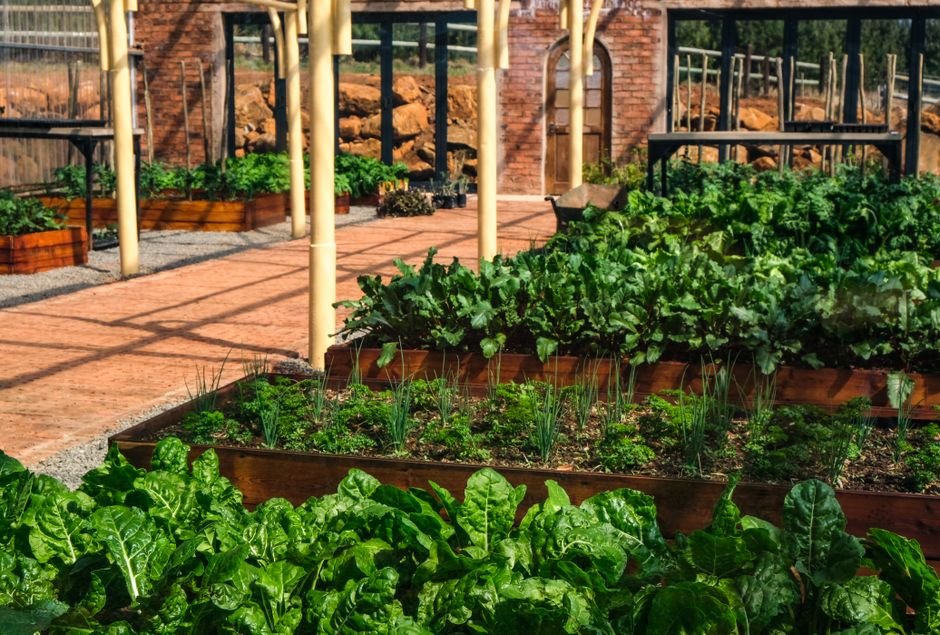
On a Saturday in June I stood at the end of the middle bed with a mug going cold in one hand and a torn envelope in the other, writing down five words. Lettuce. Beans soon. Chard now. Tomatoes no. Basil lots. That envelope became the week’s dinners, and it was the first week in about a year that I did not throw anything out.
Before that, my meal planning happened at the kitchen table on Sunday morning with a phone in my hand, and the garden was an afterthought I remembered around Wednesday when something had already gone soft.
The walk comes before the list
The sequence matters more than anything else here. If I write the plan first and then go look, the garden becomes a supply problem. I have decided we are having a certain thing, and now I need those ingredients, and whatever is actually ready gets ignored because it was not in the plan.
If I walk first, the garden sets the terms. I am not deciding what I want, I am reading what is available and building around it, which is a completely different mental exercise and is honestly more fun. It also removes the moment where I stand in front of the refrigerator on Thursday realizing that the chard I was going to use on Monday is now a problem.
The walk takes about ten minutes. I am not counting anything precisely. I am sorting into now, soon, and not yet, and that is enough resolution to plan a week.
Now, soon, and not yet
Now means it has to be eaten in the next two or three days or it will decline. Lettuce that is thinking about bolting. Zucchini that is at the size I like. Anything that is at its peak. These get assigned to specific nights, early in the week, and they are non negotiable.
Soon means it will be ready midweek or next weekend. That is planning information, not this week’s dinner. Knowing beans are four or five days out means I do not buy beans, and it means I leave a slot open on Thursday.
Not yet is everything else, and the only thing I do with it is stop thinking about it. This category used to eat a lot of my attention because I would look at green tomatoes and start planning around them optimistically. They were never on schedule.
Two anchors and four improvisations
I do not plan seven dinners. I tried and it fails every time, because a real week has a night where someone works late and a night where nobody wants to cook.
What I plan is two anchors. Two dinners that are actually specified, that use the biggest now items, and that I commit to. Everything else is a loose idea. Eggs with whatever greens are left. Pasta with something. Rice with something on top. Those are not meals, they are formats, and they absorb whatever the garden throws at me.
The formats do most of the real work. A pan of eggs will accept almost any green thing. Rice will accept almost anything cooked down. Having three or four of these in my head means I never stand in the kitchen holding a bunch of something with no idea what to do with it, which was the exact moment that used to send things to the crisper drawer to die.
Where it falls apart
It falls apart in two predictable ways and I have stopped being surprised by either.
The first is the heavy week, where three crops come in at once and the walk produces a now list too long for seven dinners, let alone two anchors. That is not a planning failure, it is a planting failure I made months earlier, and the plan cannot fix it. Those weeks I skip straight to cooking things down on Saturday afternoon and giving some away.
The second is the empty week, which happens more than anyone admits. There is a stretch in late spring where the early stuff is finished and the summer stuff is a month out, and the walk produces almost nothing. Herbs and maybe some greens. I used to find this demoralizing. Now I just accept that the garden contributes a garnish that week and I plan normally.
There is also the night the plan simply loses. Somebody gets home late, we order food, and the anchor meal moves to tomorrow. Because the anchors are the items with the shortest window, a one day slip is usually survivable. A three day slip is not, and I have lost heads of lettuce that way.
Why this beat every storage trick I tried
I spent a couple of seasons trying to solve waste at the back end. Better containers. Damp towels around greens. Jars of water for herbs on the counter. Freezing things. All of it helps a little at the margins, and none of it addressed the actual mechanism, which was that food came inside without a job.
A vegetable in my refrigerator with no assigned meal is on a countdown, and my track record of finding it a job before the countdown finishes is poor. A vegetable that already belongs to Tuesday gets eaten on Tuesday. The whole thing turned out to be a scheduling problem wearing a storage problem costume.
The other thing the walk does is stop me from harvesting more than I need. When I know that four dinners have garden components and I know roughly what they are, I pick that amount and leave the rest outside. The plant is a better refrigerator than my refrigerator, and it charges nothing.
The envelope stays on the counter
I keep the list somewhere visible, which sounds trivial and is not. When the plan lives in my head it evaporates by Wednesday. On the counter, it survives.
It is also a record. Looking back at a stack of these from last year told me things I would not have noticed otherwise, like the fact that I wrote lettuce lots on four consecutive weekends in May and then never again, which is a planting schedule problem I could see plainly once it was in my own handwriting.
It is a scrap of paper and ten minutes with cold coffee. It has done more for how well I eat out of this garden than anything I have bought.