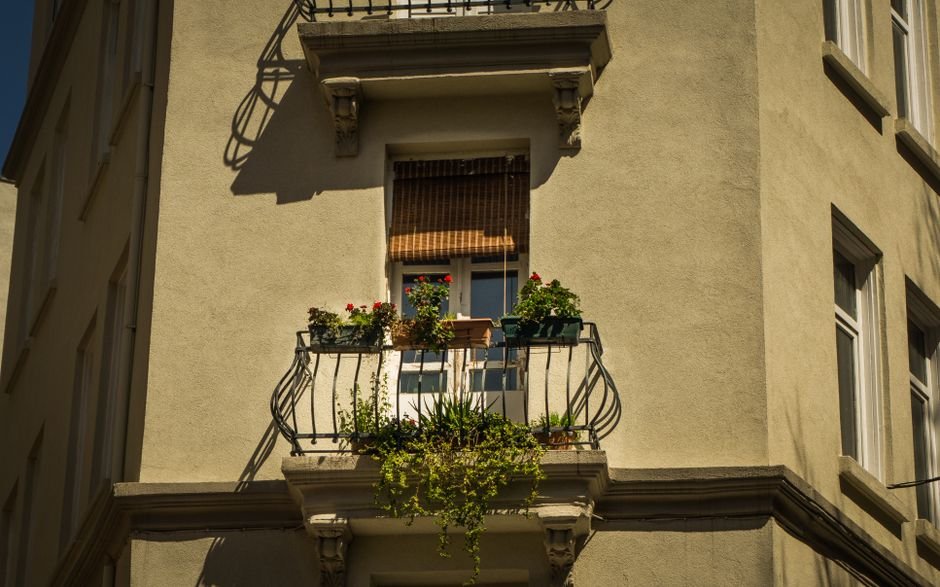
On a Saturday in May I made coffee, put a chair on the balcony, and made a note every hour of where the sun was actually hitting. Not where I assumed it hit. Where the bright patch physically was. By evening I had a scribbled page that told me something I had been getting wrong for two years: the end of the railing where I had been putting my tomato was in shade by early afternoon, and the corner I had been using for a watering can was the brightest place I owned.
I moved everything the next morning. It was the single most useful thing I have done out there.
Why I stopped guessing
My first year I placed pots by convenience. The heavy ones went where I could set them down without carrying them further, the herbs went by the door because that is where I would reach for them while cooking, and the tomato went at the far end because that end was empty.
Then everything grew badly in a specific way. Stems stretched long between leaves. Plants leaned hard toward the railing. The tomato flowered and then dropped flowers. I assumed I was watering wrong or feeding wrong. I was not. They were reaching for light, which is the plainest signal a plant can send, and I read it as a feeding problem for an entire season.
How I mapped it with nothing
There is no equipment in this. I picked a day I was home, went out roughly every hour, and drew a rectangle on paper with a rough shading of where the bright patch was. That is it. I did the same thing again in August and it looked different, because the sun sits higher and the shadow from the next building falls differently.
What I ended up with is not hours of sun as a number, because I do not trust myself to count that in a way that means anything. What I ended up with is a ranking. This end is brightest and gets sun into the afternoon. The middle gets the morning. The wall corner gets a bit of glancing light and that is all. Ranking turned out to be enough.
The other thing the ranking gave me was a reason to stop moving pots around on a whim. Before the map I would shuffle things whenever a plant looked unhappy, which meant nothing ever settled and I never learned anything, because a plant that gets moved three times in a month tells you nothing about any of those positions. Now a pot goes somewhere for a season and I judge it at the end.
What the shady end can still do
The wall corner is not dead space, which was my other early assumption. Mint is perfectly happy there and honestly seems to prefer not being roasted. Parsley and chives do fine. Leafy things in general tolerate the shady end because they are only building leaves, and I have found the leaves there are actually a bit softer and slower to bolt in high summer than the ones baking on the railing.
So the shady end became the herb and leaf end, permanently. I stopped trying to negotiate with it.
The trade I make for that is real, though, and worth saying out loud. Softer leaves in the shade also means slower leaves. A pot of salad on the shady end takes noticeably longer to be worth cutting than the same pot would in full sun, and in early spring when it is still cool it can sit there looking static for weeks. I have learned to sow that end earlier than feels sensible, because it will need the extra time.
Fruit asks for much more than leaves
The thing that took me longest to accept is that these are not the same problem. A lettuce that gets modest light grows slower and smaller and is still a lettuce. A tomato that gets modest light will make a green plant that flowers and then does very little, because ripening fruit is a much larger investment for the plant.
That is why my tomato was flowering and dropping. It was not sick. It was doing arithmetic. Once it went to the brightest end, it set fruit and ripened them, slowly, but it got there. I now treat the bright end as reserved for fruiting plants and I do not let anything else squat there just because there is room.
Reflected light helps a little
My balcony wall is a pale color and I noticed the plants closest to it did marginally better than the ones on the open side of the same shady stretch. I am not going to oversell this. It is a small effect and it did not turn a shady corner into a sunny one. But if I have two equally shaded spots I now put the plant against the pale wall rather than against the dark railing.
I tried leaning a piece of white board behind a pot for a few weeks to push this further and honestly could not tell a difference worth the clutter. I took it out.
Some of that is just where I live. The building opposite is taller than mine, so my bright window is a morning window and there is nothing I can do about that. It is a useful thing to accept early, because a lot of growing advice is written for people with a garden and open sky, and it quietly assumes light is available. On a balcony, light is the scarce resource and everything else is comparatively easy to fix.
Choosing plants for the light I have
The whole thing collapses into one habit now. Before I buy or sow anything I ask which of my three zones it is going into, and if the answer is the bright end, something else has to leave. That constraint is not fun but it is real, and pretending otherwise just produces a balcony full of stretched, unhappy plants that never quite do anything.
If you are about to start a small space garden and you only do one thing first, do the Saturday with the notepad. Not the seed order, not the pots. Find out where your light actually goes. Everything else is a decision you can only make properly once you know that.